FBT 2026: What's the latest?
With the current Fringe Benefits Tax year approaching on 31 March, now is a great time to know what’s happening in the area of FBT. The topic of focus this FBT year-end is the provision of commercial-type vehicles in your business for both owners and employees.
LARGE UTES AND TRUCKS: NOT ALWAYS EXEMPT UNDER THE ATO's SAFE HARBOUR RULES (PCG 2018/3)
Many employers assume that all utes, trucks, and workhorse‑style vehicles are automatically exempt from Fringe Benefits Tax (FBT).
However, under the ATO’s safe harbour guidelines in PCG 2018/3, an FBT exemption only applies when all specific conditions are met. This means not every commercial‑type vehicle – and not every pattern of use – qualifies for the exemption.
THE ATO's FOCUS ON UTES IN 2026
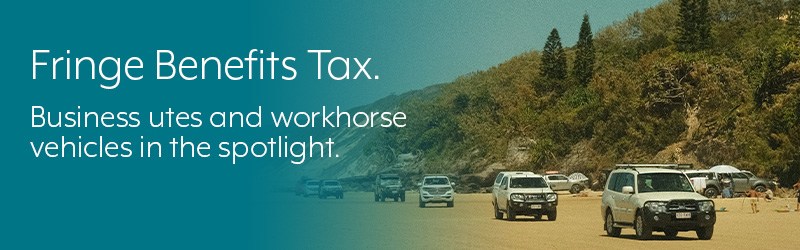
The ATO has made it clear that utes are a compliance focus this year, and we have already seen active reviews underway. The ATO is also reviewing social media posts, including cases where work utes have been spotted at Fraser Island (K’gari) and other popular holiday locations.
The ATO is even checking social media activity to see how and where business vehicles are being used.
Janolla Weatherhead | Senior Accountant
With FBT taxed at 47%, errors can lead to significant tax liabilities.
SAFE HARBOUR CONDITIONS UNDER PCG 2018/3
- Eligible vehicle – the employer provides an eligible vehicle to a current employee.
- Business‑related use – the vehicle is provided for work duties.
- Value under LCT threshold – the vehicle’s GST‑inclusive value at purchase is below the Luxury Car Tax (LCT) threshold.
- Not salary packaged – the vehicle is not part of a salary packaging arrangement.
- Private use strictly limited – employer has a written policy limiting private use and receives employee confirmation.
- Home‑to‑work travel limits – travel between home and work must not add more than 2 km to the usual route.
- Strict private travel limits – private trips must not exceed 1,000 km annually or any single return trip over 200 km.
EXCEEDING THE LUXURY CAR TAX THRESHOLD
A vehicle with a GST‑inclusive value above the Luxury Car Tax (LCT) threshold at acquisition is automatically excluded from PCG 2018/3.
2026 Luxury Car Tax thresholds:
- Fuel‑efficient vehicles: $91,387
- Other vehicles: $80,567
Common vehicles under ATO scrutiny:
- Dual‑cab utility vehicles
- RAM, Chevrolet and other extra‑large trucks
- High‑performance or high‑value utility vehicles
IS THE FBT EXEMPTION STILL POSSIBLE FOR LARGE VEHICLES WITH GREATER THAN 1 TONNE CAPACITY?
Yes — in some cases. Even if a vehicle cannot use the safe harbour guidelines because it exceeds the LCT threshold, this does not automatically mean the FBT exemption is unavailable.
If you believe this situation applies to you, contact your Business Adviser at The Peak Partnership.
RECOMMENDED ACTIONS FOR EMPLOYERS
- Maintain a written vehicle‑use policy restricting private use and outlining business‑related use.
- Request employees complete an annual statutory declaration confirming compliance and actual business use.
- Require employees to keep a detailed logbook showing business use to support exemption or reduce FBT exposure.
- Review all your vehicles in your business fleet in March every year, update and maintain a list of current drivers for all of them (take special note for cars that may have been reallocated between employees, or previously driven by ex-employees).
Plug-in hybrid vehicles no longer FBT-exempt
From 01 April 2025, plug-in hybrid electric vehicles no longer qualified for the FBT exemption unless:
- the use of the vehicle was exempt before 01 April 2025, and
- there is a financially binding commitment to continue providing private use of the vehicle on and after 01 April 2025.
If there has been a break or change to that commitment on or after 01 April 2025 then the exemption normally won’t be available any more.
SUMMARY (need some FBT help?)
Utes and trucks are a significant ATO focus in 2026, and many commonly used vehicles do not fit neatly within the safe harbour rules.
With the ATO actively monitoring social media and targeting high‑value vehicles, employers must ensure strong policies, statutory declarations, and logbooks are in place to manage the high compliance risk associated with the 47% FBT tax rate.
At the Peak Partnership, we're here to help you understand what is a very complex area of Australian Taxation Law, so feel free to reach out to your Business Adviser on (07) 3360 9888 or contact us here.